Hunter Rabbit: A Playful Display Font for Editorial Charm
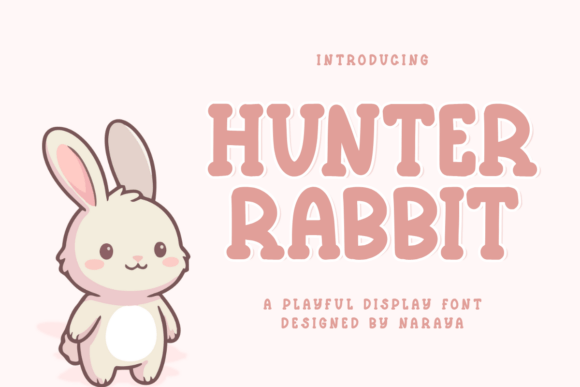
Hunter Rabbit is a spirited, hand-drawn display font that brings warmth and personality to editorial projects without sacrificing clarity. Its slightly uneven baseline, gentle curves, and expressive letterforms evoke the spontaneity of chalkboard sketches or artisanal signage—yet it remains highly legible at larger sizes. As a display font, it’s not designed for body text, but rather for moments where tone, attention, and visual identity matter most: magazine covers, blog headers, ebook titles, quote graphics, and branded digital printables.
What sets Hunter Rabbit apart in editorial design is its balance of playfulness and polish. Unlike overly ornate script fonts or rigid geometric displays, it feels approachable—ideal for lifestyle blogs, wellness newsletters, or creative workbooks where authenticity and friendliness are part of the brand voice. The lowercase ‘a’, ‘g’, and ‘y’ feature subtle alternates that add rhythm without distraction; ligatures like “fi” and “fl” flow naturally, supporting clean typographic texture in headlines and pull quotes.
In practice, Hunter Rabbit shines when used intentionally—not everywhere, but where it earns its place. For a seasonal recipe ebook, it works beautifully on chapter openers (“Spring Greens”, “Summer Sweets”) while letting a warm serif like Merriweather or a neutral sans like Inter carry the ingredient lists and instructions. In a digital magazine layout, it anchors cover lines with quiet confidence, especially when set in all caps with generous tracking. On printable planners or coaching worksheets, it transforms section headers (“Weekly Intentions”, “Gratitude Log”) into gentle visual cues—inviting rather than commanding.
For newsletter creators, Hunter Rabbit adds memorable flair to subject-line graphics or featured quote cards shared across social platforms. Because its forms are distinct but not eccentric, it scales well across devices: crisp in PDF exports, clear on mobile previews, and charming in printed lead magnets like habit trackers or reflection journals. Just avoid using it below 24pt in digital layouts or smaller than 18pt in high-resolution print—its charm lives in its presence, not its subtlety.
Pairing Hunter Rabbit thoughtfully is key to strong editorial hierarchy. It pairs exceptionally well with readable serif fonts (e.g., Lora, Crimson Text) for long-form blog posts or ebook body copy—creating contrast that guides the eye from headline to narrative. For captions, navigation menus, or sidebar notes, a clean, low-contrast sans serif (like Open Sans or Source Sans Pro) provides functional counterpoint. Avoid pairing it with other display or script fonts; its personality needs breathing room. When designing a content brand—say, a wedding planning guide or a mindful parenting newsletter—Hunter Rabbit becomes the consistent accent that signals voice and values before a single word is read.
Editorial designers will appreciate that Hunter Rabbit includes standard Latin characters, basic punctuation, and support for common Western European languages. While it doesn’t include extended Cyrillic or Asian language sets, its coverage is sufficient for English-language blogs, ebooks, templates, and digital magazines targeting U.S., U.K., Canadian, and Australian audiences. Check the included file set for stylistic alternates and OpenType features—some versions offer swashes or contextual substitutions that lend extra nuance to title treatments.
Licensing is an important practical note for publishers and digital product creators. Hunter Rabbit is a commercial font, meaning usage rights extend to client work, paid newsletters, ebook covers, downloadable worksheets, and template kits—as long as you’ve acquired a valid license. It’s permissible in PDFs distributed to readers, SVG files embedded in web-based planners, and PNG graphics used in Instagram carousels or Pinterest pins. What’s not covered under standard licenses is redistribution of the font file itself (e.g., including the .OTF in a Canva template for resale) or embedding it directly into web fonts via @font-face without a web license. Always verify the license terms before launching a course workbook, Shopify theme, or Notion template bundle.
Consider how Hunter Rabbit supports reader engagement beyond aesthetics. In a crowded feed, a quote graphic set in Hunter Rabbit stands out—not because it shouts, but because it feels human. In a printable planner, its friendly weight reassures users that this tool is designed *with* them, not just *for* them. On a blog post about slow living or creative courage, its soft edges echo the message before the first paragraph begins. That kind of alignment between typography and intention is rare—and valuable.
It’s also worth noting where Hunter Rabbit isn’t the right choice. Skip it for dense article intros, footnotes, data tables, or mobile navigation bars. Don’t force it into tight spaces or low-resolution thumbnails. And resist using it for logos requiring extreme scalability—while it works well for social media banners or sticker designs, fine details may blur at very small sizes or on fabric prints. Its strength lies in deliberate, contextual application—not ubiquity.
For independent content brands building recognition across formats—email, web, print, and digital products—consistency matters. Using Hunter Rabbit across your ebook covers, quote graphics, and workshop handouts creates visual continuity that readers begin to associate with your voice. That recognition builds trust over time, especially when paired with thoughtful layout decisions: ample white space, intentional line breaks, and restrained color palettes that let the type breathe.
If you’re refreshing your publication’s typography system, start small. Try Hunter Rabbit on your next blog header or newsletter banner. Test it against your current body font. See how it changes the temperature of a quote layout—or how it softens the formality of a resource guide. Good editorial typography doesn’t just look good—it supports understanding, reinforces voice, and honors the reader’s time. Hunter Rabbit does all three, quietly and confidently.